
CenTax was back at the Labour and Conservative party conferences this autumn, where we co-hosted two fringe events with the Chartered Institute of Taxation (CIOT). Our panel discussions both asked the same question: does the British tax system back entrepreneurs?
These events came alongside the publication of our report Capital Gains Tax on Entrepreneurs: Should the UK have a ‘Unicorn Relief’? However, both discussions ranged well beyond tax, extending to the wider ecosystem that supports entrepreneurship in the UK, including infrastructure, skills, regulation, finance, energy costs, public procurement and digital connectivity.
Most of the support available for entrepreneurs in the UK tax system comes through Capital Gains Tax (CGT), a key area of focus for CenTax Directors Arun Advani and Andy Summers. At Labour Party Conference in Liverpool, Arun made the case for fundamental CGT reform, which our report concludes would be better for growth than a special relief, in addition to raising revenue. At Conservative Party Conference in Birmingham, Andy focused more specifically on the CGT relief Business Asset Disposal Relief (BADR), arguing that it was poorly targeted and that any replacement should be aimed at founders building high-growth businesses. This argument underpins the rationale for any theoretical design for a ‘Unicorn Relief’ as set out in CenTax’s report.
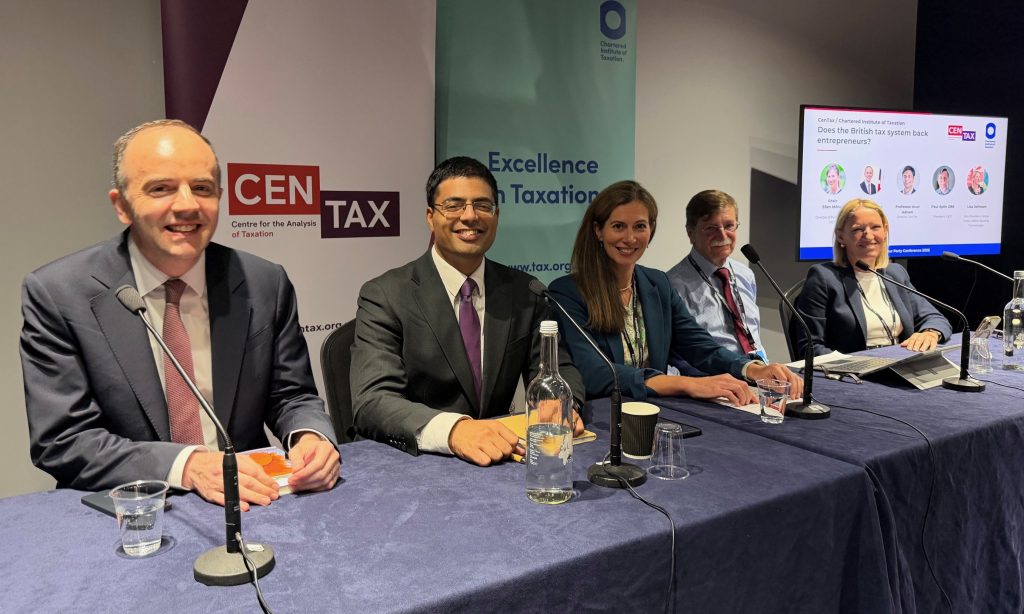
Labour Party Conference, Monday 28 September
Chaired by Ellen Milner, Director of Public Policy at CIOT, our Labour event brought together CenTax Director Professor Arun Advani along with panellists the Rt Hon James Murray MP, Financial Secretary to the Treasury and Paymaster General; Paul Aplin, CIOT President; and Lisa Johnson, Vice President of Global Public Affairs and Corporate Communications at Starship Technologies.
Arun made the case that the CGT system as it stands taxes entrepreneurs too much in some cases and too little in others. Illustrating this he compared the example of an individual who borrows against their house to invest in their business, and receives no recognition for the interest paid, with that of a consultant who leaves a large firm to set up a small private business and ends up paying only around half the tax they would pay if they were salaried.
He also pointed to two other features of the CGT system that discourage entrepreneurship. Founders who have built a successful business can leave the country and sell it without paying CGT, providing they stay away for six years. Further, because CGT is not charged on death, older owners have a reason to hold on to a business until they die rather than passing them on. CenTax’s CGT reform package would address each of these problems in the system.
James Murray noted the work that the Government has done already to support entrepreneurs, such as doubling the Enterprise Investment Scheme and Venture Capital Trust investment limits and gross asset thresholds at Budget 2025. He described Enterprise Management Incentives as a world leader in helping start-ups and scale-ups to attract and retain key staff. He said the Government will respond in due course to HM Treasury’s Tax Support for Entrepreneurs call for evidence.
Paul Aplin said founders and investors want different things from the tax system and described how complex reliefs such as EIS can be. He called for a wider debate on the barriers to growth and productivity, noting that “tax isn’t everything, but it is quite a lot of the problem”.
Lisa Johnson picked up a similar theme, making the case that helping businesses grow depends much more on a joined-up approach across government, including procurement, public investment and regulation. For Lisa, the UK should take scaling up as seriously as it takes starting a business.
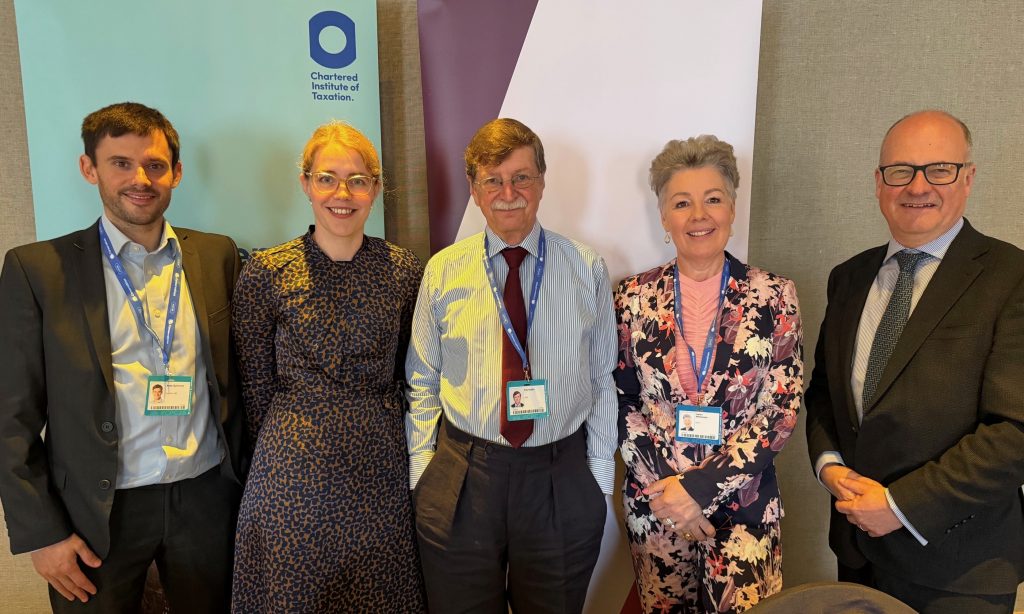
Conservative Party Conference, Tuesday 6 October
In Birmingham, CIOT Chief Executive Helen Whiteman chaired a panel featuring CenTax Director Professor Andy Summers along with John Cooper MP, Shadow Exchequer Secretary to the Treasury; Paul Aplin, CIOT President; and Alice Jeffries, Head of Tax Policy at the Confederation of British Industry.
Andy examined each of the three ways entrepreneurs interact with the tax system, identifying a key issue with each. First, the decision to start a business, where the only tax relief available is BADR, a situation Andy described as “the worst of all worlds”. As Andy set out, BADR is not generous enough to change the behaviour of founders building large businesses (on a £100m gain, it reduces the effective tax rate from 24% to only 23.9%), yet it benefits some people who would not usually be considered entrepreneurs, such as the consultants Arun described in Liverpool who set up small private businesses. A better-designed relief would do the opposite, which is what the ‘Unicorn Relief’ in CenTax’s report sets out to do.
Second, Andy examined the incentive to invest. Given that CGT currently taxes inflationary gains, Andy argued for an investment allowance along the lines of the old indexation allowance, which would also address the cost-of-borrowing problem Arun raised in Liverpool.
Third, Andy explored running the business. Here Andy noted that recent changes to employer National Insurance have widened the gap between the tax treatment of investing in staff and investing in capital, arguing this is the wrong direction at a time of increasing use of AI.
Drawing on his own experience of setting up a news agency, John Cooper said the UK is good at producing start-ups, but that they run into problems when they need to scale up.
Alice Jeffries built on the criticism of BADR. She argued that its £1 million lifetime limit rewards founders for selling early, especially when combined with a reliance on venture capital, whose investors want their money back relatively quickly. Her proposed solutions come not just from the tax system, but include regulation and access to more stable capital for growing businesses, such as pension funds.
Paul Aplin agreed, warning that many entrepreneurs now plan for an exit rather than for growth, which is bad for the long-term health of the economy, and called for more of the proceeds from selling a business to be reinvested in new UK businesses.
You can read CIOT’s write-up and recordings of both debates here.
