
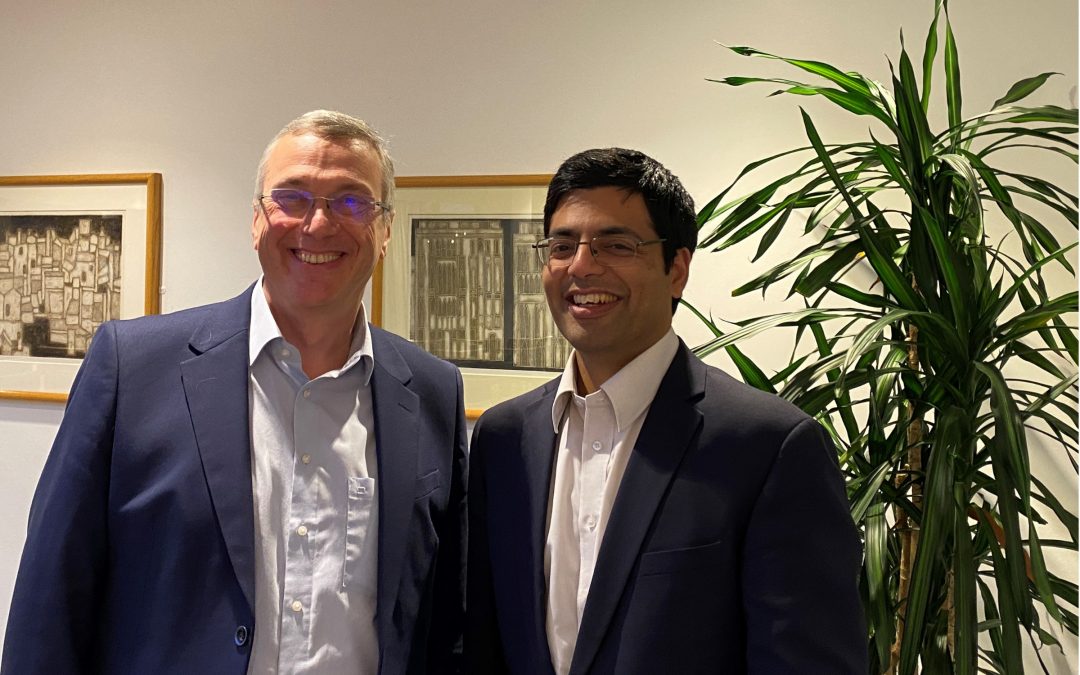
CenTax Director Professor Arun Advani was ‘In Conversation’ with Warwick Vice-Chancellor and President Professor Stuart Croft this week at an event to introduce the Centre to members of Warwick’s University Council and guests from across the University.
Founded by Warwick’s Professor Arun Advani and Dr Andy Summers of LSE, CenTax made its public debut during the 2024 party conference season and was formally launched with a Parliamentary reception that autumn.
The Vice Chancellor explained why the event was a slightly belated anniversary celebration: “We were planning on having the Warwick launch in November last year – but we couldn’t because the Chancellor of the Exchequer decided to have the budget on that same day and Arun and his team were rather busy.”
Describing the event as a “fireside chat,” the Vice Chancellor put questions to Professor Advani before inviting questions and comments from the floor.
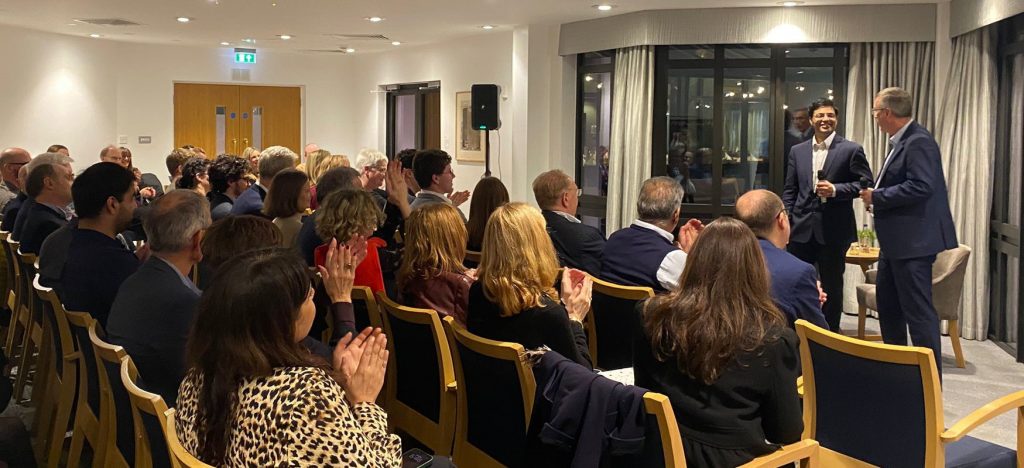
Arun explained how CenTax grew from his working partnership with Dr Andy Summers at LSE: “I’ve been working with administrative tax data since it became available to researchers about thirteen years ago. Eight years ago I teamed up with Andy, who is a lawyer by background. And one of the great things about this interdisciplinary partnership is that while I have a good understanding of the numbers and how to use the data, I don’t always know where to look in terms of the tax system to explore some of the really niche issues.”
As the team grew, their research developed and their work gained public attention it made sense to formalise the partnership into a research centre to benefit from a more unified voice and additional resources.
According to Arun, an unexpected benefit of adopting a more formal identity has been greater engagement with the machinery of government – an organisation seems easier to bring into the government’s consultation structures than individual researchers.
Arun explained how engagement can include taking the CenTax team to the new Darlington Economic Campus for a day of presentations and workshops – “walking them through what we know, how we know it, how we can feel confident about it and how they can use that information in – say – submissions to the Office for Budget Responsibility (OBR) on spending proposals.”
“Given how much the fiscal numbers have ended up being a block on policy changes in the last few years, I think that’s the most powerful thing we can be doing at the moment.”
Invited to reflect further on how CenTax engages with government, Arun said: “The first thing to stress is that we are completely non-partisan. Before the last election we engaged with five of the major parties – in the main, they get in touch with us to ask for analysis. But often we do our own prospective work, on areas we think are important but others might not yet be considering. We also engage heavily with the civil service, which is where institutional knowledge is held in a way that outlasts the vagaries of the UK political system!”
“We engage carefully and thoughtfully with all of the different parties. We know the different interests that they have and what parts of our research they will engage over.”
“It’s not always the easiest balance to manage. The first thing we do is help them understand where we as academics come from. They are used to a classic think tank that can be neatly put in a box – that’s a left think tank, that’s a right think tank. And we’re a kind of hybrid – a think tank in a university? And you’re a professor? What does that mean? It’s an interesting way into the conversation and a good way for us to explain that we are here to try and provide the best evidence.”
“We try to start by listening a lot. What are they interested in? Why? The thing that we want to help any party with is not ‘tackling the problems we think the country has’ – it’s ‘tackling the problems they think the country has’. Finding the best evidenced solutions for their tax priorities.”
Reflecting on the experience of being in the eye of the political storm over inheritance tax changes, Arun said: “We don’t get to tell the government what to do. We say, ‘here is the current state of policy, here is what the effects of alternatives would be’ – and I think that is the proper role for us as academics and experts.”
“The right place for us as experts is to give people – including the public, though the media –information, and then for MPs to debate in Parliament whether any policy trade-offs are worthwhile.”
Questions from the guests covered topics from public attitudes to tax levels, to whether there are any limits on political groups which academics could or should engage with, and what tax decisions were the best and worst in history.
